
How much screen time is too much?
11 November 2026
Almost every parent worries about screen time, but the answers about how much is "too much" vary depending on who you ask. Let's look at what the research actually says, without exaggeration or guilt.
What major health organisations recommend
The World Health Organization and several national paediatric associations broadly recommend:
Under 2 years: avoid screen time almost entirely, except video calls
2–5 years: up to 1 hour a day, of quality content
5+ years: clear limits, with what is watched mattering more than the exact hour count
Important nuance: these are general guidelines, not strict rules that fit every family the same way.
Why "how much" isn't the only right question
Research shows that the content and context of screen time matter as much as the quantity. Passive, aimless scrolling has a different effect than watching a film together as a family, or engaging with educational, interactive content. What screen time replaces also matters — whether it's coming out of sleep time, outdoor play, or other meaningful activity.
What's actually concerning
According to research, the biggest risks are linked to:
Sleep disruption — screen time right before bed interferes with sleep
Physical inactivity — when screen time replaces physical activity
Social replacement — when screens replace real interaction rather than supplementing it
These are more specific, more actionable concerns than a blanket "less screen time is always better" message.
Practical principles that actually help
Model it yourself. Children imitate adults' screen behaviour more than they follow rules they're told.
Create screen-free rituals. Mealtimes, the hour before bed — predictable screen-free moments are easier to maintain than a vague "less screen time" goal.
Choose quality over quantity. Interactive, creative, educational content is different from passive consumption — both count as "screen time", but they aren't equivalent.
Where paper naturally fits
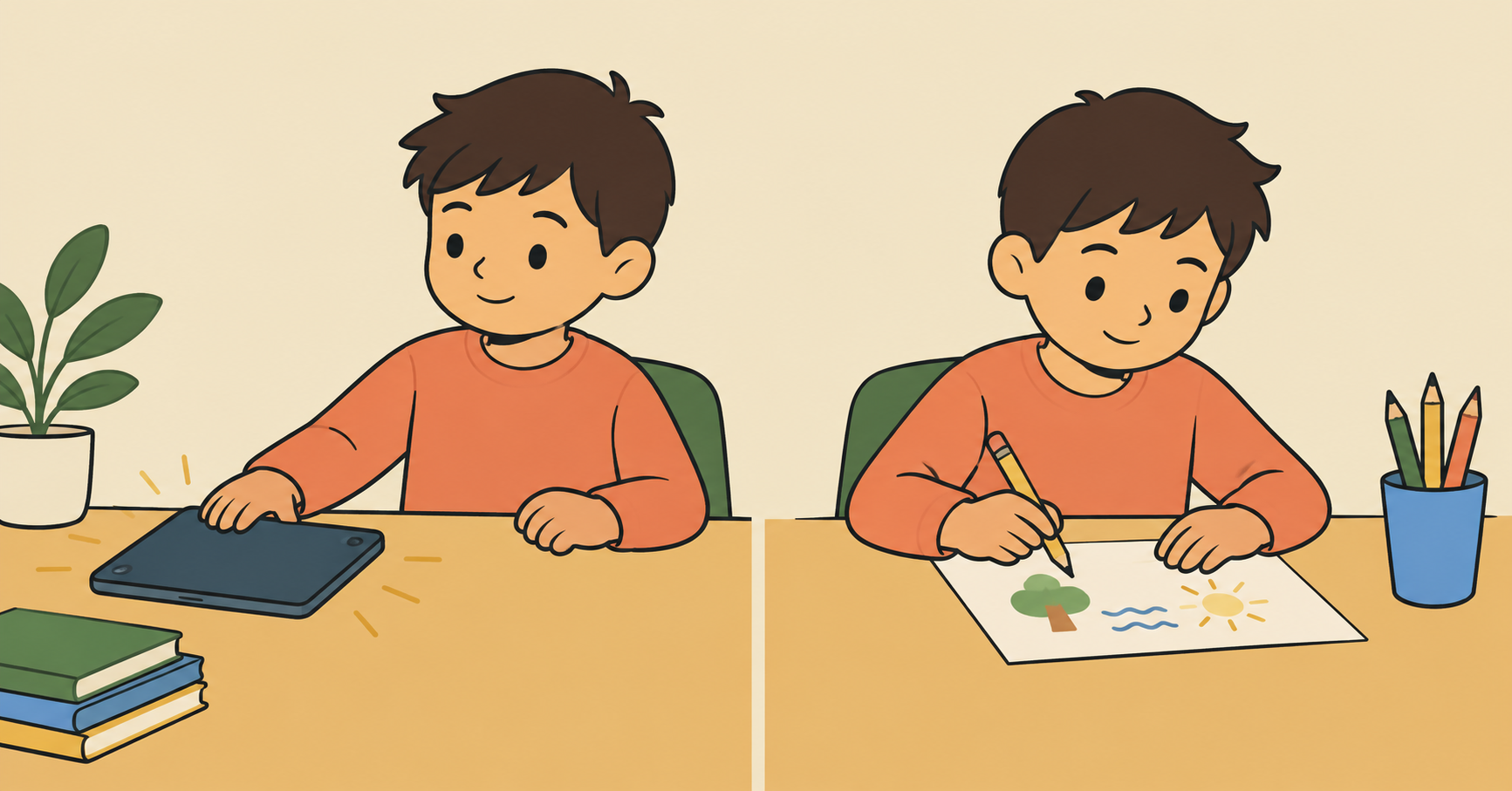
This isn't an argument that screens are bad — they're a tool like any other. But paper and pencil offer something a screen simply doesn't: fine motor development, a genuinely screen-free moment, and a different kind of cognitive engagement (as we wrote in our earlier post on handwriting).
Kindlo's goal isn't "screens are evil" — it's simply to offer one quality, screen-free activity among the things a child does during their day.
Want to try a screen-free, personalised learning activity? Try a free sample worksheet — 30 seconds, no sign-up required.