
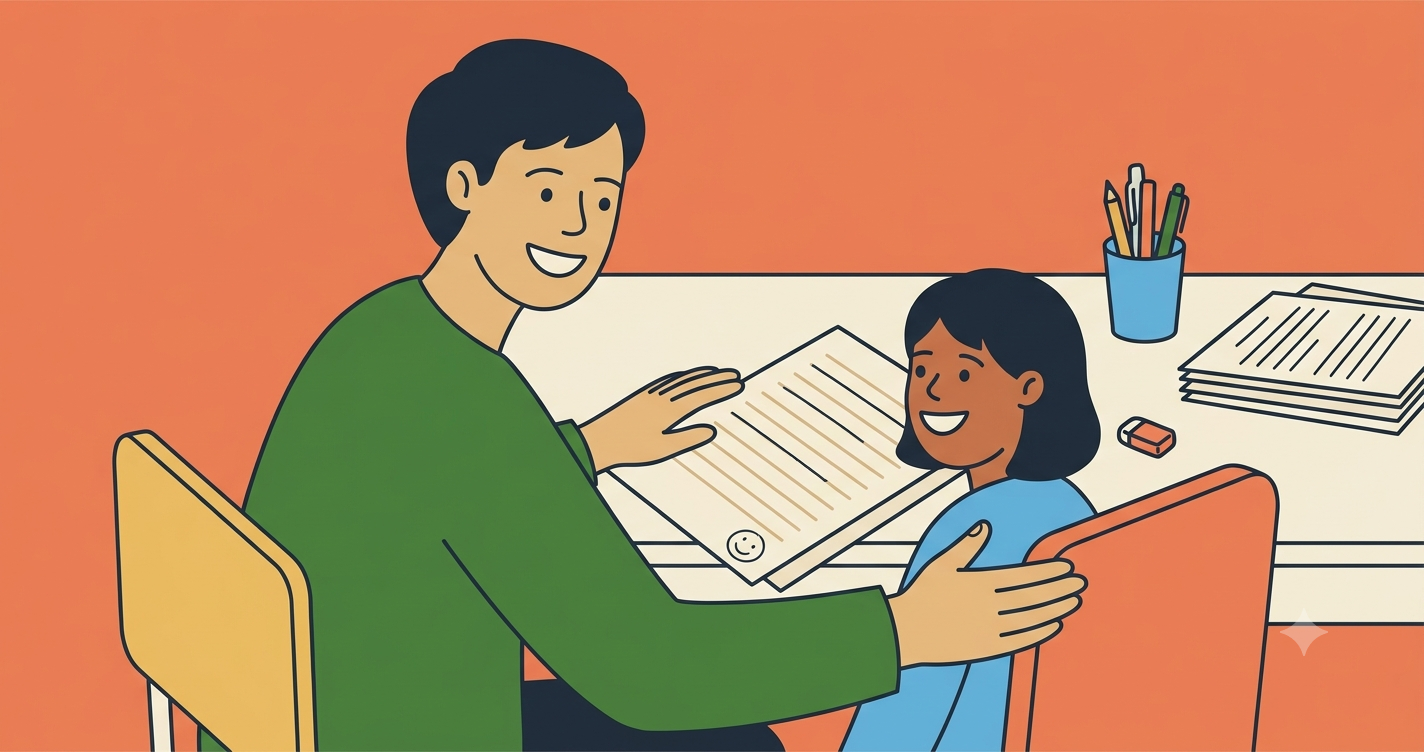
How to talk to your child about their worksheet so they want to come back
6 August 2026
The worksheet itself is only half the job. What happens afterwards — what you say, how you react — often matters more for whether a child wants to try again next time.
Most parents don't think about this deliberately. But small word choices make a big difference.
Avoid "did you get it right?"
This question feels natural, but it directs attention to the outcome rather than the process. The child starts thinking about right/wrong instead of what they learned or tried.
A better question: "What was the most interesting part?" or "What was the trickiest bit?" — these open up a conversation instead of closing it with a right/wrong judgement.
Praise effort, not just results
"You're so smart" feels positive, but it ties the child's identity to the outcome. Next time it's harder, the child feels something is wrong with them, rather than the task simply being harder.
"I noticed you tried a few different ways to solve that" focuses on the process, which the child can repeat even when the result isn't perfect. This is the foundation of what psychology calls a growth mindset.
Ask before you help
When a child gets stuck, the natural instinct is to help right away. But before stepping in, it's worth asking: "What have you tried already?" or "What do you think should happen here?"
This gives the child a moment to think before you intervene. Most of the time, a child finds the answer themselves if given a little more time — and the feeling of "I figured it out myself" is far more valuable than a correct answer handed over by a parent.
Let the self-rating speak first
When a worksheet ends with a self-rating (like "was this easy, medium, or hard?"), let the child decide before you share your own opinion. This gives the child ownership over their own learning.
If a child says "that was hard," don't rush to say "no it wasn't" — even if it looked easy to you. Ask instead: "What made it hard?" This gives you real information about where the child actually is, and gives the child the feeling that their experience is being taken seriously.
End with something specific, not general praise
"Great job!" is nice, but it's forgotten quickly. A specific observation sticks around much longer: "You got stuck on that addition problem, but you tried three different ways before finding the right one — that's exactly what mathematicians do."
This gives the child real evidence of their own ability, rather than just a phrase that sounds the same every time.
Why all of this matters
A child's relationship with learning is shaped largely by these small moments — not by a few big achievements, but by a hundred small conversations after each worksheet. If those moments feel safe, curious, and free of judgement, the child wants to come back. If they feel evaluative and pressured, the child starts avoiding them.
Every Kindlo worksheet includes three simple self-rating faces and a small conversation prompt for the parent — precisely so this conversation is easy to start, without you having to come up with it all yourself.
Curious what a personalised worksheet would look like for your child? Try a free sample worksheet — 30 seconds, no sign-up required.