Kumon vs Kindlo — an honest comparison for parents
3 August 2026
Kumon is a familiar name for many parents — it's been around for decades, and most people have heard of the method even if they've never used it. If you're looking for a home learning solution for your child, you'll likely consider it at some point.
But Kumon and Kindlo solve the problem in very different ways. Here's an honest, fact-based comparison — without exaggerating in favour of either.
Price
Kumon typically costs €100–200 per month, depending on the learning centre and number of subjects (maths and reading are usually separate courses). On top of that, there's travel time to and from the centre, usually twice a week.
Kindlo costs €4.90 per month on the starter plan. That's roughly 20–40× less expensive.
The price difference isn't random — it reflects a fundamental difference in format, which we'll get into below.
Format: centre vs home
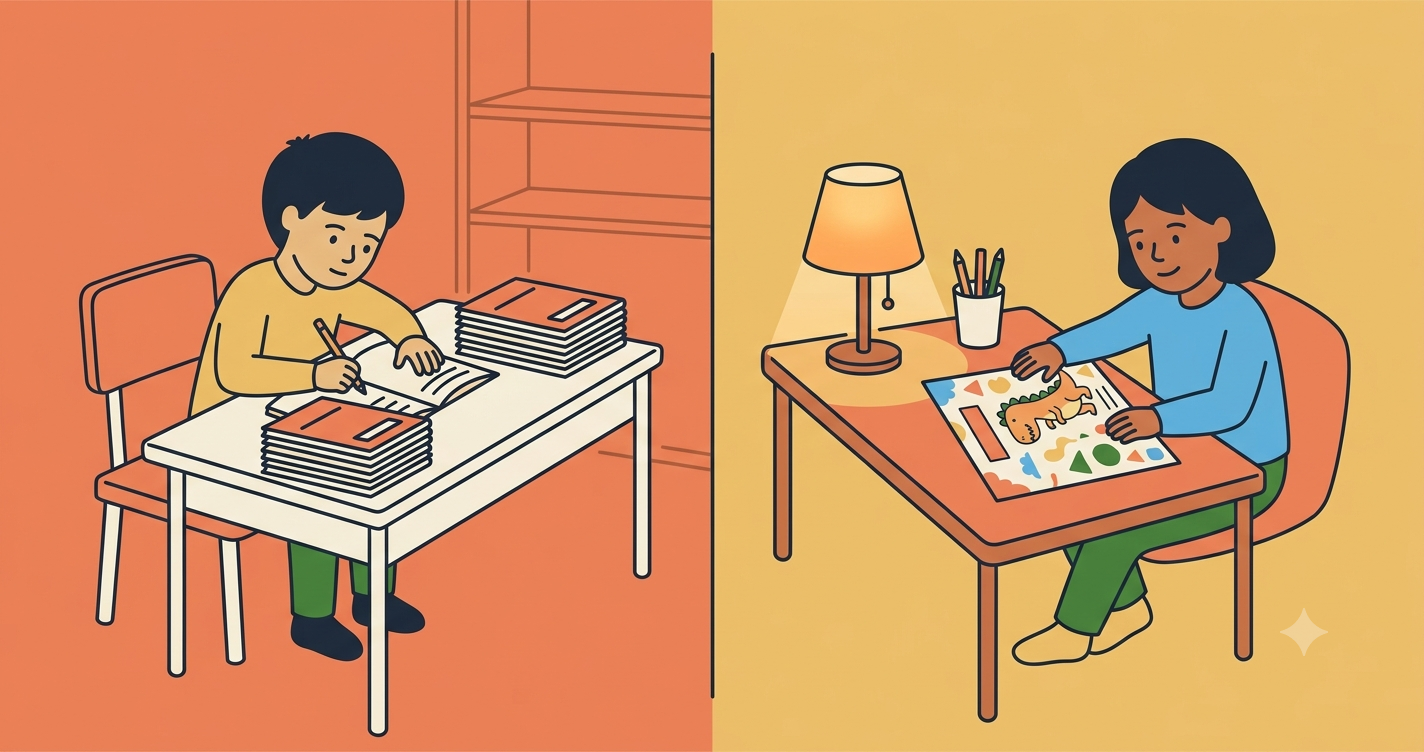
Kumon is built around a physical learning centre. Children attend 1–2 times a week and complete workbooks there and at home under instructor supervision. This works well for families who value structure and a routine outside the home.
Kindlo works entirely from home. Worksheets arrive digitally (print at home) or by post (as a ready-made booklet). There's no travel time and no fixed schedule to commit to.
Neither format is inherently "better" — it depends on your family's lifestyle. If you value routine outside the home and direct instructor contact, Kumon may suit you better. If you value flexibility and a home-based rhythm, Kindlo may suit you better.
Personalisation
This is the biggest substantive difference.
Kumon's method is a standardised progression — every child moves through the same sequence of exercises, at a pace that's predetermined. It's a proven method, but it doesn't account for a child's individual interests or adapt content to their personal themes.
A Kindlo worksheet adapts automatically to a child's level and interests. If a child loves dinosaurs, that shows up in maths and language exercises alike. If a child needs more practice in one area but is already ahead in another, the difficulty adjusts per subject — not as a single level across everything.
Time commitment
Kumon requires regular centre visits — typically twice a week, plus homework in between. Altogether, families spend a meaningful amount of time on it weekly, including travel.
Kindlo's Starter plan is 3 worksheets per week, each taking 10–20 minutes. That's roughly 30–60 minutes a week, with no travel involved.
What's similar
To be fair, there are similarities too. Both are built on the idea that regular, structured practice helps a child develop. Both believe a child should progress at their own pace rather than the pace of a school class. Kumon's "one small step at a time" philosophy and Kindlo's Vygotsky-based zone of proximal development approach actually share a similar goal — keeping the child right at the edge of their ability.
The difference is mainly in how that's achieved: Kumon through standardised steps applied the same way to everyone, Kindlo through automatic individual adaptation.
Who each one suits
Kumon may suit you if:
You value structured, out-of-home routine
You want direct instructor feedback
Your budget allows for €100+ per month
Your child does well with a standardised progression
Kindlo may suit you if:
You prefer a flexible, home-based format
You want material that adapts to your child's individual interests
You're looking for a lower monthly cost
You want a clear picture of progress without centre visits
Neither is "better" in an absolute sense — they suit different families for different reasons.
Curious what a Kindlo worksheet would look like for your child? Try a free sample worksheet — 30 seconds, no sign-up required.